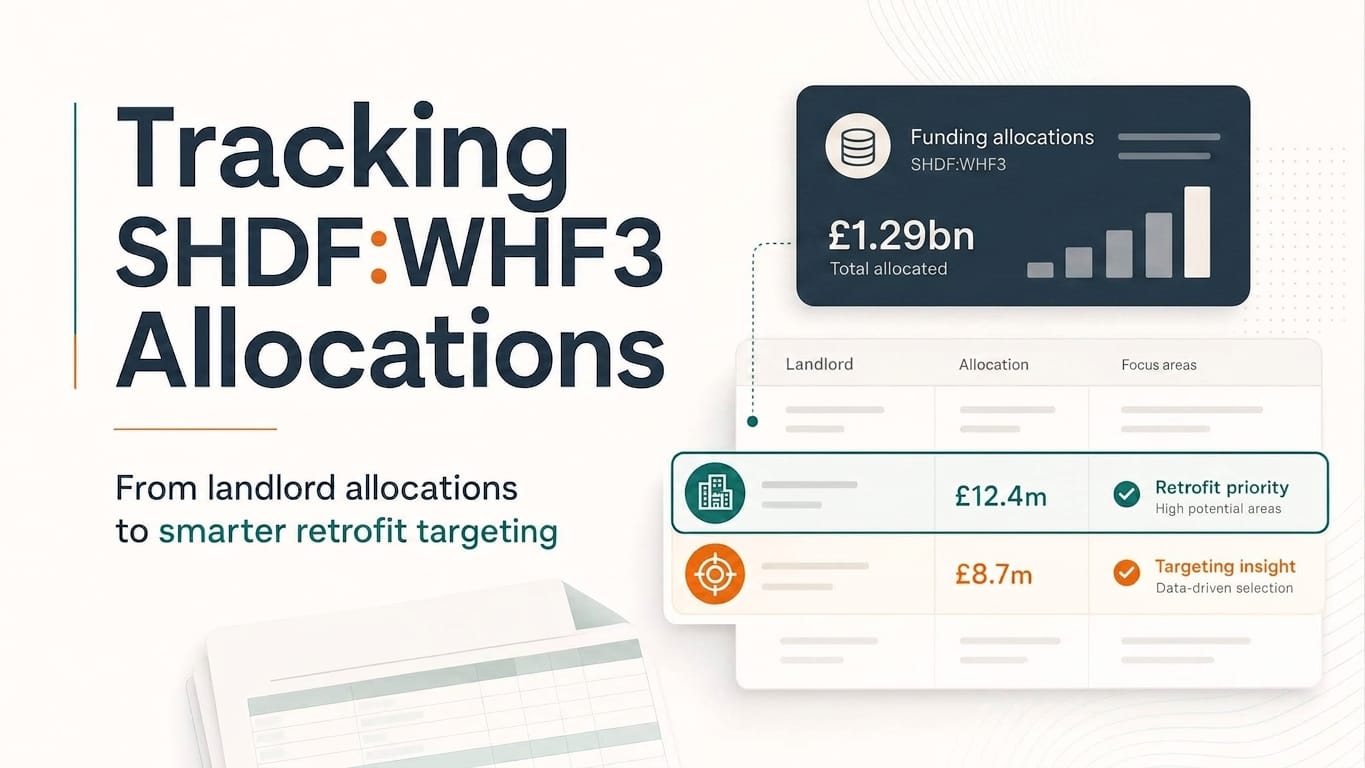
If you want to track Social Housing Decarbonisation Fund allocations effectively, the main challenge is not finding a single headline announcement.
The harder part is turning funding signals into a practical picture of which landlords may be relevant, where their housing geography suggests useful areas to investigate, and how that should shape follow-up.
That requires more than a spreadsheet of awards.
Start with the funding signal, but do not stop there
SHDF allocations are useful because they point to landlord-level programme intent. But on their own, they rarely tell the full commercial story.
An allocation does not specify exactly where that spend will land geographically. It tells you that a landlord has funding, not which individual homes, estates, or neighbourhoods will definitely receive upgrades.
A funding award does not answer every important question:
- Where are that landlord’s homes actually located?
- Which regions should a supplier prioritise first?
- What other housing or retrofit indicators strengthen the case?
- Which teams or decision areas are most relevant?
To get commercial value from SHDF tracking, the funding signal needs context.
Build a view by geography
The most useful way to work with SHDF information is usually geographic, but with the right caution.
That means looking at:
- where the funded landlord’s homes are located
- how those locations line up with existing territories
- where wider retrofit need or stock patterns seem more concentrated
- which surrounding areas may also justify attention
A geographic view helps teams move beyond “someone got funding” and toward “where should we actually spend time first?”
PREEMPT is useful here because it can help show where a landlord’s homes are geographically located. That is different from proving which homes will receive upgrades, but it gives a much better base for area-level planning than the allocation headline alone.
Combine SHDF with wider housing and retrofit context
Funding activity becomes more useful when you can read it alongside other indicators, such as:
- the efficiency profile of stock in the wider area
- improvement headroom
- housing and asset patterns that support the retrofit story
- existing client or account coverage in the patch
- whether the area fits your operational footprint
That creates a better prioritisation model than a list of allocations on its own.
Use tenders and contracts to get closer to real project spend
If you want a clearer view of where spend is turning into actual projects, SHDF allocations should be combined with tender and contract intelligence.
That can help identify:
- where a programme is moving into procurement
- which contractors or delivery routes are involved
- whether activity appears tied to a specific patch or work package
That is often a more defensible way to move from landlord-level funding into project-level follow-up.
Separate tracking from assumptions
One risk in this area is jumping too quickly from funding news to commercial conclusions.
A cautious approach is better.
SHDF allocations may suggest:
- a stronger reason to investigate an area
- a clearer rationale for contact
- better timing for a conversation
They do not automatically prove:
- immediate buying intent
- the exact geography of spend
- a live requirement for your exact service
- the right contact route
- short sales cycles
That distinction matters if you want outreach to stay credible.
Use SHDF tracking to improve targeting, not just reporting
There is nothing wrong with producing a simple monitoring list. But the bigger value usually comes when SHDF tracking improves commercial decision-making.
For example:
- Which landlords with SHDF allocations overlap with our strongest sales territories?
- Which landlords operate in regions where retrofit conditions already looked promising?
- Which accounts deserve follow-up now, and which only need light monitoring?
- Where is there enough evidence to justify a more tailored outreach message?
That is the point where tracking becomes commercially useful.
A practical workflow
For most teams, a sensible workflow looks like this:
- Record SHDF allocation signals.
- Identify where the funded landlords’ homes are geographically located.
- Compare that housing geography against existing sales territories or growth targets.
- Layer in wider housing and retrofit context.
- Add tender and contract signals where available to see whether spend is becoming more specific.
- Prioritise the accounts and areas where the case for relevance is strongest.
- Research the likely decision areas and contacts only after that.
That order helps prevent the common mistake of chasing names before the account logic is clear.
Where PREEMPT fits
PREEMPT is useful here because it can help teams work with geographic and housing-related context rather than treating funding data as an isolated list. That makes it easier to compare areas, understand where a funded landlord’s homes are located, and decide where follow-up is most likely to make sense.
It does not prove which specific homes will receive upgrades, but it gives teams a more credible area-level planning view. Tenders and contracts can then help narrow that further toward real project spend.
Final thought
Tracking SHDF allocations is valuable, but only if it helps you focus better.
The goal is not to collect every funding mention.
The goal is to understand where those signals create a more credible reason to investigate, prioritise, and start a useful conversation, without overstating what the funding data proves.
If you want to combine funding signals with housing geography and tender context, PREEMPT can help turn SHDF tracking into a more practical targeting workflow.
Comments are closed